Latest Entries »

When people say Second Life is “just a game” and people shouldn’t take it so seriously, they are usually implying that it is ridiculous to experience real emotions (positive or negative) over something that happens to their avatar in-world.  If anyone can keep a distance and a distinction between themselves and their online presence, that’s fantastic.  Good for them.  However, it is easy to see why people experience real emotional consequences from things that happen in a virtual environment.  Our avatars represent ourselves; not literally, but in a way that we connect with them.  We associate ourselves with our avatars.  We invest our time, money, and attention in our virtual presence.  And the other avatars we encounter in Second Life are not Artificially-Intelligent programs, but other people who have made similar investments in their online selves.

Despite how obvious it should be that it is normal to feel affected by things that happen in Second Life, I was still shocked and surprised at my real emotional response during a session of roleplay in the Seven Isles.  The character I play is not very far removed from my actual personality, but there is enough of a distinction that I consider Cherno to be a separate entity from Chernobyl Rasmuson (and therefore from my real-world self).  Despite Cherno being, in my mind, a distinct character separate from myself and with a backstory that is not based on real events in my past, somehow I still found myself in tears during a particular roleplay session.

View full article »

Look What I Did

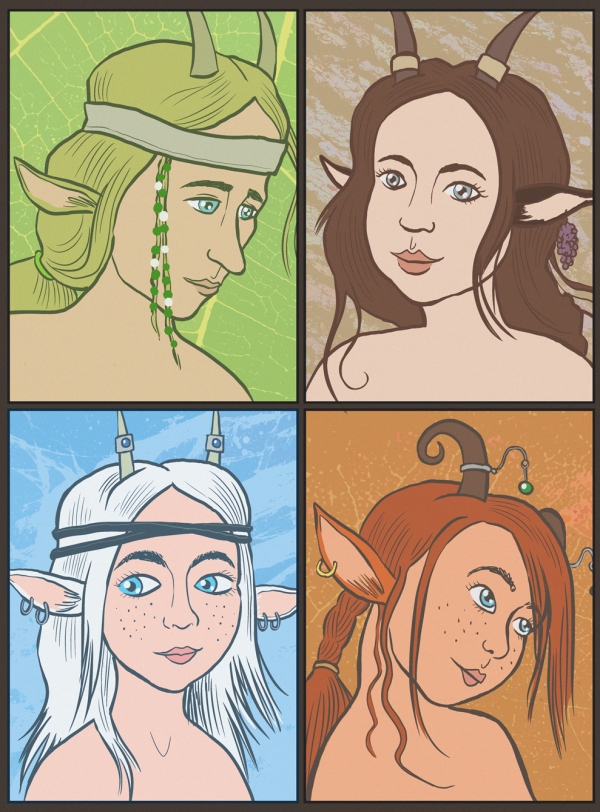
I won’t try to hide it — I made some faun/satyr avatars for sale, and I’m here to tell you about them.

Hoof and Horn Market Stall

Hoof and Horn Avatars in the Seven Isles Market

Currently these complete* avatar sets are available for adult males and females.  Soon I hope to release the child faun/avatar sets as well.

*Sets do not include skin, hair, or eyes.  Everything else on display is included.

If you’ve considered becoming a faun or satyr in Second Life, and you have L$600, you can buy these avatars in the Second Life Marketplace or in-world at the Seven Isles Market.

I am currently setting up a Mainstore location as well, where it will be possible to buy individual body parts, so you can mix together an avatar set of your very own!

Want to see some pictures of avatars in Second Life using Hoof & Horn avatars?  We have a Flickr group.  Also, you can follow Hoof & Horn’s updates, sneak peeks, and other news on our blog.

Americans have recently celebrated Thanksgiving, and it actually made me think of a parable of sorts.  Bear with me, here.

There was once a large family, who traditionally celebrated the Thanksgiving feast at Grandma’s dining table.  Grandma would spend two days preparing the main courses—turkey, stuffing, candied yams, dinner rolls, pumpkin pies, and green bean casserole—and our five aunts and uncles would bring side dishes like salad, deviled eggs, corn, gelatin, and cranberry cobbler.  With so much food and such a big family gathered together, Thanksgiving was a resounding success every year.

Then one year, our aunts and uncles decided that although they did love their mother and appreciate her Thanksgiving efforts, they were getting a bit bored with the predictability and repetition of the meals.  Each of our aunts and uncles got the idea to host their own Thanksgiving feast, each with a slightly different menu that was a variation of Grandma’s traditional main courses.  Aunt Margaret, for instance, knew that Grandma’s green bean casserole was never popular, and so she replaced it with stuffed bell peppers.  Surely everyone would prefer stuffed bell peppers, and celebrate Thanksgiving at her house!  Aunt Rheba was a creative woman with many interesting ideas, and she was able to obtain an emu as the main course, rather than a turkey.  Surely everyone would come to her house for Thanksgiving, because she was offering them something completely new and different!  Uncle Roger was a health-conscious man who cooked his Thanksgiving feast without butter or salt, and using artificial sweeteners instead of sugar.  He was going to prove that you could still have a delicious banquet without all the fat.  Surely everyone would celebrate Thanksgiving at his house, where they could eat a healthy and satisfying meal without feeling guilty!

Thanksgiving Day came and our aunts and uncles each prepared their own feasts at their own homes, and Grandma as well prepared her annual feast at her home.  In every house, there was a lot of food… but not a lot of people.  Only our aunts, uncles, and their children partook of their own feasts.  And Grandma… well, since Grandpa was no longer with us, she sat alone on Thanksgiving Day with a table full of food that was quickly growing cold.  Aunt Rheba called Uncle Roger and asked why he didn’t celebrate Thanksgiving at her house.  “I had my own feast to attend.  Why didn’t you come to my house?”  he replied.  Uncles and aunts called one another asking the same question, and the answer was always “I had my own feast to attend”.  When Grandma called her children and asked why they didn’t show up for Thanksgiving, they gave the same answer.

And so, our aunts and uncles wasted a lot of their efforts, preparing a banquet that only their spouses and children attended.  Too much food was made—more than each family could possibly eat—and so a lot of it went into the trash eventually.  And that year, Thanksgiving was very lonely for everyone.

The family vowed never to repeat this fiasco again.  They wanted to be together, most of all.  Secondly, they all wanted something a little different at the feast, and a chance to shine and show off their culinary creativity.  For the next year, they planned to gather at Grandma’s house as usual.  Aunt Margaret convinced her mother that they could leave out the green bean casserole this year, replacing it instead with stuffed bell peppers which she would provide.  Uncle Roger baked a low-carb sugar-free pumpkin pie, for those who wanted such an alternative.  Aunt Rheba roasted her own emu at home and brought a portion of it to Grandma’s house.  And so on it went, so there was a lot more variety on the dining table that year.  More important than the variety of food available, though, was the fact that everyone was together.

Owning land in Second Life—whether a parcel or an entire simulator—is a lot like hosting a Thanksgiving dinner.  You provide something, and you hope people come and enjoy it.  Let’s just use the ubiquitous Second Life club as an example.  Your club is your Thanksgiving feast.  Your turkey, stuffing, and pumpkin pie are your dance balls, DJ, and the building itself.  Aunt Margaret is a DJ who plays big band and swing, and decides to start her own club themed solely after such an era.  Uncle Roger is someone who thinks clubs have too many particles and scripts lagging the place, so he starts his own low-lag club.  Aunt Rheba is someone who is full of radical and novel ideas, but without her own land to implement them.  These people could convene at “Grandma’s” club, and pool their talents and ideas for the enjoyment of all.  The club could have an occasional “Big Band Night” where Aunt Margaret would DJ.  Uncle Roger could help the club owners find scripts that don’t lag as much.  And Aunt Rheba could make suggestions for new and unique events or layout of the club.

In Second Life, it’s quite easy for someone to own or rent land for whatever purpose.  And it may be fun establishing your own club or shop and doing things the way you like.  But then the consumers are spread thin among a huge supply of providers and entertainers, just like when everyone hosts Thanksgiving dinner at their own houses.  It is a lot of effort on the parts of the land owners, to prepare a “feast” for a large audience.  And a lot of that effort is wasted, because the audience ends up being just the owners’ handful of friends.  It’s not just effort that is wasted, either.  Think of the money the land owners pay to Linden Lab every month, just to entertain or serve a small cluster of people.  If it’s more important to gather everyone together, then why not bring your talents and offerings to Grandma’s table?  There would then be a nice variety of entertainment, and all the aunts, uncles, cousins, and children would meet and enjoy the company.

Glow and Full-Bright Sins

It needs to be said that everyone is entitled to his or her own opinion and tastes.  I would never try to enforce conformity to a single individual’s preferences.  However, it is often helpful for Second Life content creators and merchants to receive feedback on their products, or to gain insight into the needs and desires of consumers in order to make products that are as appealing as possible.  Having said that, allow me to guide you through what I would consider proper (and improper) use of full-bright and glow features.

Enable Basic Shaders in Preferences

(Click to view this image in original size.)

First of all, make sure you can see glow in the first place!  Sometimes the reason we find items that are glowing like the sun itself is because the creator of that item couldn’t even see that it was glowing.  Without “Basic Shaders” enabled in your graphics preferences, you won’t be able to see glowing objects, no matter how high you set the glow setting.

Both objects in this picture have the maximum glow setting, 1.00, but it does not appear to glow if “Basic Shaders” is not enabled.

(Helpful hint: if you can’t enable “Basic Shaders”, try ticking the “Custom” box next to the “Quality and Performance” slider.  Now you should have the option to enable “Basic Shaders” and therefore see glowing objects.)

Comparison between dark- and light-textured objects with glow

Darker-textured objects appear not to glow as much as light-textured objects.

Glow is like make-up; less is more.  If you must make a glowing item, keep it tasteful.  Where the threshold of “tasteful” is depends largely on the lightness or darkness of the object’s texture.  Light-textured objects appear to glow much more than darker-textured objects, and it is often necessary to decrease the glow level on light-textured objects.  The Full Bright option also affects how bright an object appears, but use it wisely as it also “flattens” the object.  (That is, Full Bright removes all object shading, creating a flat, uniform, unrealistic shape.)

There are certainly many situations where it is prudent to use glow.  As a few examples, one might use glow:

  • in light sources (lamps, neon signs, light bulbs, spotlights, flames and fire)
  • in magical items (fairy accessories, magic potions, staffs and wands, mushrooms)
  • in jewelry (specifically on the gemstones themselves, rarely on the chains or bands)
How Glow affects texture

Too much glow completely obliterates the texture.

Remember, less is more.  Even in cases where it makes sense to use glow, cranking the glow level all the way up to 1.0 can be disastrous!  Using maximum glow will result in the texture of the object becoming impossible to see; so if you’re using a beautiful texture, don’t negate it with too much glow!

As you can see in the picture on the left, even a glow level of 0.50 (that’s half the maximum!) is enough to blanche the texture to the point where it cannot be recognised.  The use of Full Bright also contributes to the whitewash effect that strong glow has on a texture.  Avoid using Full Bright unless you’re sure that it is absolutely necessary!  Now let’s take a close look at what Full Bright actually does.

Night and day comparison

Full-Bright objects appear the same at both night and day.

Objects in Second Life will be shaded according to sunlight, moonlight, and (if enabled) local lighting.  Using the Full Bright option makes a texture appear as if it were evenly lit from all sides, thus removing any natural shading from the object.   Case in point: the full-bright spheres at the bottom of the picture on the right could be flat cylinders.  Without shading, there’s no way to tell the difference.

Full-bright objects will appear the same at all times of day; for this reason, full-bright objects will stand out at night time! Sometimes this is a desired effect… but not always.  Here are a few examples of items which should never be made full-bright without an exceptional reason:

  • Hair
  • Shoes
  • Trees, grass, flowers, and other landscaping items
  • Houses and buildings (the lack of shadows inside a building can be very disorienting!)
  • Items made of wood
Full-Bright trees and bird at night

Is there a good reason for this?

The above photo was taken at night time.  Everything else in the area was dark as it should have been, but these trees and the giant bird were illuminated by Full Bright.  If they were magical trees, or in some way special so that they should draw one’s attention, it would be understandable.  But these were just ordinary trees, standing out against the scenery rather than blending into it.

Does everything in Second Life need to conform?  Not at all.  In fact, using Full Bright and glow are excellent ways to make an item stand out against the background, to draw attention to it.  Just don’t use Full Bright and glow arbitrarily.  Make sure there is a good reason for using these tools, and keep it reasonable and tasteful.  Misuse of Full Bright and glow is one easy way to spot the work of an amateur, so use it wisely!

Corinda’s recent blog post sparked in me the urge to reply, but as I realised my reply would most likely be very long, I opted to make it an entry of my own.  I suggest reading hers first; it’s okay, I’ll wait right here.

For me, Second Life came along right when I needed it.  I had just moved to a foreign country where I knew only one person, and I was unemployed for a stretch of about a year and a half.  Cooped up in the house all day and with no sense of purpose or direction, I slowly grew depressed and anxious.  Then my man read an article in the news about someone who had made a living through a virtual world called Second Life, and this certainly caught our attention.  We created accounts almost immediately–I as Chernobyl Rasmuson, and he as Thor Freenote.  He decided it wasn’t his thing after only a couple days of noobhood, but I kept going and I’ll tell you why.

The majority of Second Life Residents see and use Second Life as a social tool for meeting new people and hanging out at fun places.  I’m not a very social person (see previous entry), so the draw for me was different, and twofold: the creative outlet with which it provided me, and just my morbid curiosity at all the bizarre things that existed or were possible in Second Life.  Attending building classes in Second Life made me feel SO good, down to my very core.  Here I was, basically a shut-in, and yet I was learning something in a virtual classroom.  I was able to interact with the instructor and my classmates, who were not mere artificial intelligence robots, but actual people somewhere else in the world.  That was supremely thrilling and fascinating to me.

Like every noob, I needed money too.  Hearing that people could hold jobs in Second Life (and having no job of my own in the real world), I was definitely eager to find employment!  In September 2007, I was hired as a Tringo hostess in South I City.  I got paid to play games and chat with people–pretty superb, if you ask me!  It was just what I needed.

Second Life did indeed fill a void in my life.  One could argue whether or not my void was filled with “healthy activities” but I think the idea that too much internet usage is “unhealthy” is an obsolete and ignorant view.  Unlike watching television, using the internet or Second Life actually requires use of the brain, to make choices and react to changes.  Internet usage becomes unhealthy when one neglects healthy or necessary real-life activities in favour of online activities.  An extreme example is the South Korean couple who spent so much time online that their infant daughter starved to death.

Sometimes when someone claims, “it’s a good thing, it makes me feel good about myself and gives me a sense of purpose,” someone will reply, “yes, but it isn’t real.”  The feelings most certainly are real.  I may not be physically present in a classroom, or receiving real currency as my paycheck, but the mental and emotional benefits are the same.  Scientific studies of the brain have shown that our brains cannot tell the difference between an object we see and our imagination or memory of that same object.  If our brain doesn’t make a distinction between real and imaginary, then maybe we shouldn’t place so much importance on the physical world and assume its superiority over all else.

Now I have been employed in the real world for the last two years, but I remain in Second Life because it does offer me a lot of creative freedom, and I am still morbidly curious about all the oddities of this virtual world.  Managing the Seven Isles means I need to sign in every day if possible, which is honestly more than I would otherwise like to sign in, but it’s a small sacrifice for the joy of having created something beautiful.  Still, whenever the electricity or internet goes out, or I’m away from Second Life for a prolonged period of time, I enjoy the time I spend in the real world.  I can quit anytime.

Confessions of an Introvert

It’s rare for me to start a conversation with anyone, and when I do, I get straight to the point.  I don’t grasp the concept of small talk; the idea of small talk strikes me as ridiculous.  Even as a teenager, I was never the kind of girl who would call my friends on the telephone just to chat or say hi.  The same is true in Second Life.  Don’t take it the wrong way, but I’m just not the kind of person who will IM my friends out of the blue.

The reason I’m writing this blog entry is because I’m afraid many of my friends–new and old–don’t understand, and take it as a bad sign if I don’t randomly contact them once in a while.  I assure you, we’re still friends though I am silent.  Maybe someone will suggest to me that I just ought to try making small talk, touching base with friends once in a while for no other reason than to say “hi, what’s up?  How are you?”  Believe me, I could.  There’s nothing physically preventing me from doing this.  But it would be entirely fake and forced.  Even though Second Life is a virtual world, I am a real person and behave the same as I would in the real world.

Then there’s the issue of Builder’s Guilt.  Other content creators can identify with this, I’m sure!  After engaging in social activities for an amount of time, the Guilt builds up.  “I’ve got work to do,” a little voice says.  Builder’s Guilt is especially intense for me, as I work a full-time job in the real world, and have about four hours to spend on Second Life on a weekday.  My To-Do List always grows longer, never shorter, so you can imagine how the voice in my head goes crazy if I’ve been locked in a conversation for an hour.  (It is remarkably hard to build AND chat simultaneously.  If I’m chatting, I’m NOT building.)

Am I always building or working?  …Yes, actually.  If I’m not, I should be.  Actually, part of the reason I don’t initiate conversations with people through IMs is because  I don’t know if they are building, spending romantic time with someone, or just about to log out.  In my real life, I was afraid to start conversations because I was never sure if someone might be having a bad day and not want to talk, or that I would be intruding upon them in some other way.  Also I think the “speak when spoken to” concept was really drilled into my head as a child, and it’s hard for me to break.

Does this mean you should not IM me at all?  By no means!  Please keep in mind that I may be working on this or that, but if you want to talk, I am available, especially if you really need to talk about something in particular.

Everyone is a…

Not long ago, I saw a movie trailer for DayBreakers, in which we are asked to imagine a world where almost everyone is a vampire.
My response:
What, you mean Second Life?

View full article »

More on that EVEN later.

Let me admit right up front that WordPress is totally foreign to me and I have no idea what I’m doing.  It’s going to take me a solid day to figure out how to do what I want to do, and learn about things I could do if I wanted.

You can ignore that bar of links and stuff to the right.  I think most of it is default stuff, and I’m not really going to touch it today or anytime soon, for all I know.

I changed the layout.  It’s alright, I suppose, though I’d rather use my own picture at the top.  That’s the first thing I’m going to do.  And, knowing me, I’m going to spend 2.5 hours cropping and editing that picture to be JUST the way I want it.  Anything less than the best is a felony, as a wise man once said.

And now a cat is lying on my left wrist, partially on my right wrist, making it extremely difficult to type well.  Backspace is my best friend.  I know what you’re going to say: “You’re bigger and stronger, just move the cat!”  Genius.  Why didn’t I think of that?  Actually I have moved this cat numerous times, but she keeps coming back.  And dagnabbit, I love her, so I’m not going to be mean over some tiny unimportant thing like how it’s difficult to type with her sleeping on my wrists.  I can work around it.  See?  I’ve typed quite a bit with this cat impeding my progress.  Luckily she doesn’t weigh very much.  I still complain about it though.  Not a day goes by that I don’t complain about SOMETHING.  If hearing someone complain is not really your idea of fun, you might not want to read future blog entries.  Just a heads-up.

I’m just filling the silence now.  Probably a good time to look for a picture I want to use for the top of my blog!

More on that later.

It’s bedtime and I’m still not done figuring out how this works.  Will resume tomorrow.  Maybe.

Follow

Get every new post delivered to your Inbox.